Last week, GM was in town for the Everything Electric Vancouver show. Ahead of the two-day event, a few members of their team invited media to discuss some of the new tech emerging from the automotive/tech company over lunch. Through the years, GM has developed software to make vehicles smarter, cleaner, and more innovative — including the use of AI. The auto/tech giant currently employs over 1,000 engineers across Canada.
On hand at the luncheon was Adam Rodriguez, GM’s Executive Director of AV Product Management. His team leads the way in Autonomous Vehicle (AV) design and implementation. Adam is no stranger to the world of tech, having worked with the team at Google to invent USB-C, and most recently at Waymo to get the first fully-driverless cars on the road.
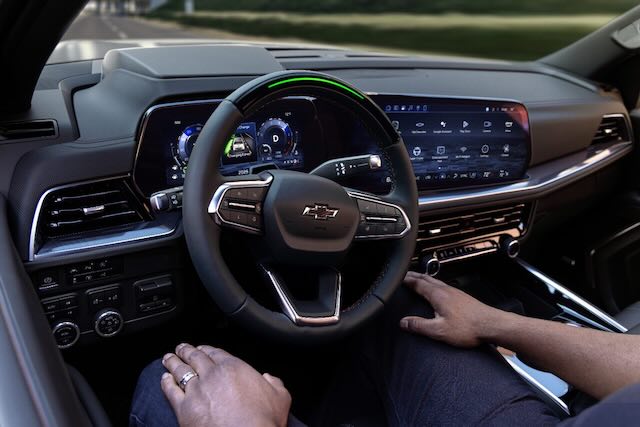
Super Cruise is their current tech product now offered in 23 GM vehicles, with that number to double next year. Launched in 2017, Super Cruise includes everything from active safety and collision avoidance technologies to hands and feet-free driving.
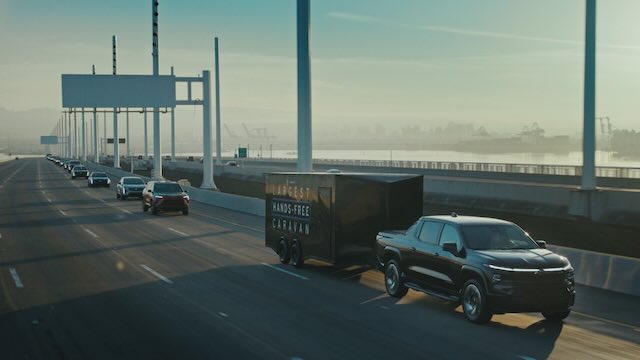
[Super Cruise caravan across the Bay Bridge between San Francisco and Oakland]
Those long drives stuck in traffic that we all dread have become a lot less stressful thanks to Super Cruise. The experience is not fully 100% automated though, as drivers are still guided via sounds or haptic prompts to keep their eyes on the road for obvious safety reasons.
GM led the way in offering hands-free driving with Super Cruise. To date, users have driven over 877,000 million kilometres (545 million miles) with no reported crashes resulting from the technology. For precision driving, LiDAR maps, cameras, sensors and GPS are incorporated to keep these vehicles centred in the lane.
Super Cruise requires an attentive driver on a compatible road. GM’s Driver Attention System helps make sure the driver is facing the road with their eyes open, ready to take control if needed. If the system detects an inattentive driver, a series of visual, haptic (if equipped), and audio alerts kick in. If the driver can’t take control for any reason, Super Cruise will slow the vehicle to a controlled stop in your lane of travel, turn on the hazard lights and calling OnStar to bring assistance to the driver.
The bottom line is that GM is focused on greater safety while giving people back their most valuable asset: Time.
Super Cruise’s footprint continues to expand with a mapped road network currently at over 965,500 kilometres (600,000 miles) throughout North America. There are several key tech features that go along with GM’s move to autonomous vehicles.
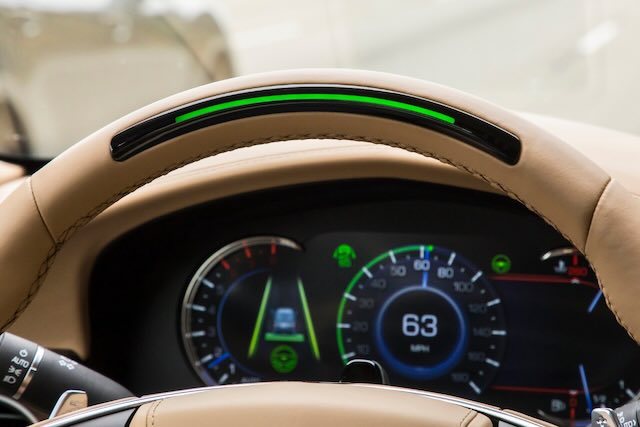
[When the steering wheel light is green, you are Super Cruise/hands-free engaged]
– Integration with Google Maps navigates to the correct lane of your chosen route
– Hands-on functionality to keep centered in lane and adapt to the speed of the driver ahead
– Upgraded Adaptive Cruise control automatically adjusts speed to match posted speed limits
What lies ahead for GM and Super Cruise? You guessed it: “Eyes-off” highway driving aka fully-autonomous personal vehicles. Visit GM online for more details.
Images courtesy of GM.