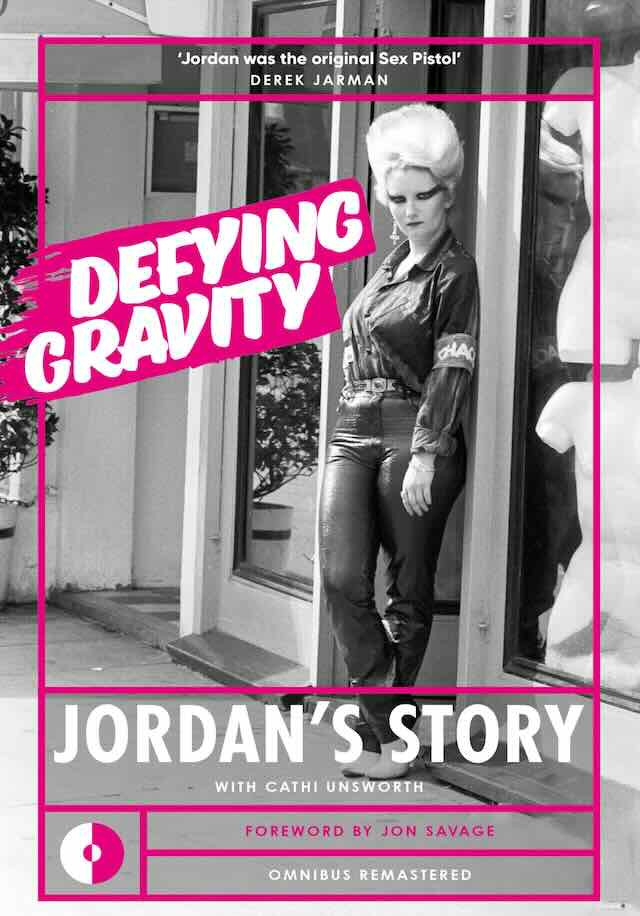
From sleepy Seaford, UK to punk rock’s ground zero, Pamela Rooke (aka Jordan) is a force to be reckoned with. She’s experienced a lifetime of gay underground clubs, worked in Vivienne Westwood and Malcolm McLaren’s SEX boutique, and has been called the “original Sex Pistol”.
After friend Sally Reid read The Great Gatsby, she passed an idea to Pamela for a name change, inspired by a character in the novel. The enigmatic, yet shrewd golf hustler Jordan Baker knew what really went down in the clandestine world of the title character’s glamorous milieu. Jordan was also the name of a popular sports car in mid-1920’s America, when the book was set. She took that inspiration and ‘ran with it’.
Together with author Cathi Unsworth, Jordan’s autobiography, Defying Gravity begins with her childhood love for ballet and dressing up in the pretty fashion that went with it. Her parents would go the extra mile in buying her lessons and clothing, even on tight budget.
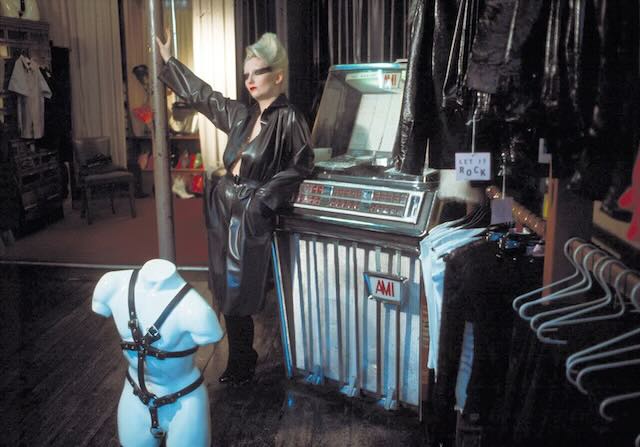
[Jordan inside SEX Boutique]
Jordan’s admiration for fashion and fabrics on the other hand likely came from her mother, who worked in a haberdasher’s shop, selling all kinds of textiles. A self-proclaimed Spock fan, the later-famous Jordan eventually came face to face with her hero, even getting a kiss from him. Right at the moment that she got to meet Leonard Nimoy, a bloke came out of nowhere and asked for her autograph, to which she replied, “‘Can you just FUCK OFF! Go away and wait until I’ve spoken to Spock!”.
Jon Savage’s short foreword sets the tone for a thoroughly enjoyable deep dive into the 1970’s London punk scene. Jordan’s highly unique approach to fashion, all created with little to no money, eventually attracted the attention of Vivienne Westwood (a former school teacher) and Malcolm McLaren (an ex-art and drama student), who employed her at their boutiques on 430 King’s Road.
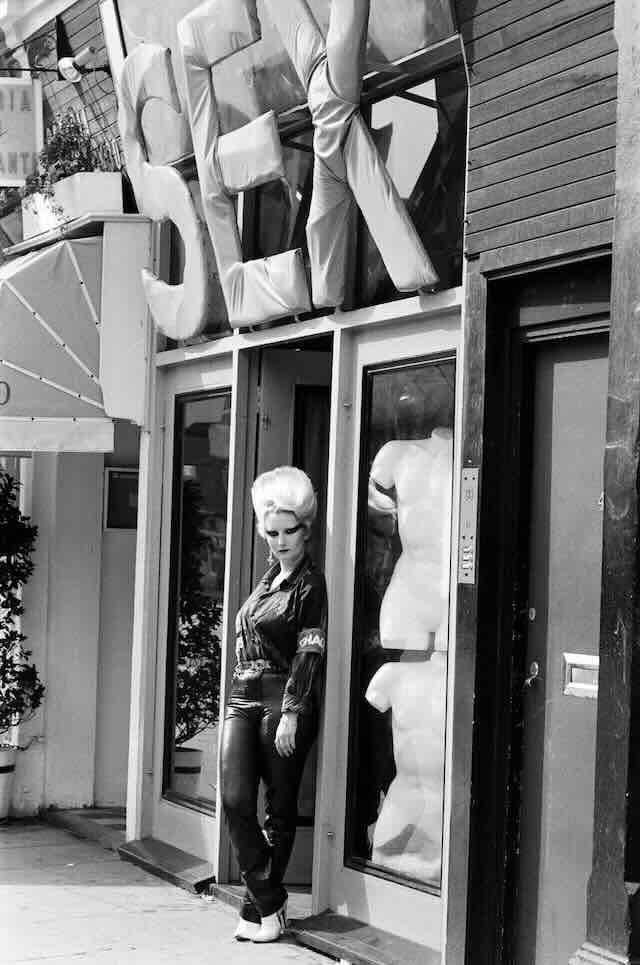
When 430 King’s Road reopened in 1974 as SEX, I knew I had to work there. I just walked in and introduced myself to Michael Collins, who was sitting on the metal medical bed that had become part of the new decor. We hit it off instantly and ended up talking for hours — perhaps because he was just as unfazed by the shop’s atmosphere as I was. — Jordan
As a 15-year-old boy, Bertie Marshall recalls about the intimidating exterior, “You couldn’t see in the front window; once you got in there, the person who was working there didn’t engage with you on any level!”
At one point, SEX had a piece of fetish sculpture on display by Lawrence Daniels, who would later become a multi-millionaire by patenting the holograms used on credit cards!
On an unrelated fame note, future Pretenders founder and chanteuse Chrissy Hynde even had a brief run working at the fetish-forward boutique.

[Malcolm McLaren, Vivienne Westwood]
Westwood and McLaren owned several shops at that location, beginning with Let it Rock (1971), then Too Fast to Live, Too Young to Die (1972), SEX (1974), and finally Seditionaries (1976; crucial to the punk movement, and renamed Worlds End in 1980).
Future Sex Pistols members Paul Cook and Steve Jones, passionate about music and clothing, would regularly visit Malcolm’s shop Let It Rock, at the time they sold Teddy Boy gear.
Malcolm didn’t just want your money, he was interested in where you were from and what you were doing. This was before we even had the idea of getting the band together. — Paul Cook
The shops attracted rock stars (Johnny Thunders, Siouxsie Sioux, Steve Severin, Adam Ant, Marco Pirroni, Grace Jones), ballet greats (Nureyev), movie stars (Helen Mirren, Jessica Lange), models (Jerry Hall) John Paul Getty III, and wealthy businessmen.
Worlds End still stands at its original location today, selling a range of Westwood unisex items (including bondage trousers and slogan t-shirts) using leftover production fabrics from previous seasons.

[Jordan, Simon Barker, Seditionaries]
McLaren also outfitted the band he managed at the time, the Sex Pistols, with items from SEX, which kind of angered Paul Cook, who believed that McLaren was using the band to market Westwood’s line during their shows. McLaren would even pick out what he wanted the band to wear. At times, they’d tell him, “I’m not wearing this! What’s this piece of rubbish?”.
Though not a musician in the band (though she did perform with — and briefly manage — an early Adam And The Ants line-up), Derek Jarman and others dubbed Jordan the “original Sex Pistol” because she was the personification of the punk aesthetic before they were famous.

[Jordan and Adam and the Ants at the Marquee Club, London, 1977; Ray Stevenson photo]
Her daring attire, bold make-up, and gravity-defying platinum-blonde beehive made her stand out, however she never presented herself in this manner to attract attention, which made her the ultimate symbol of nonconformity. She was both fearless and bad-ass, and is rightfully credited with creating the London punk look.
Jordan’s defiant look was threatening to the point of the British Rail guards often moving her to a first class train compartment in order to separate her from other passengers. It became common for people in Seaford to say, “That bloody weirdo was on the train again today”, yet Jordan remained unfazed.
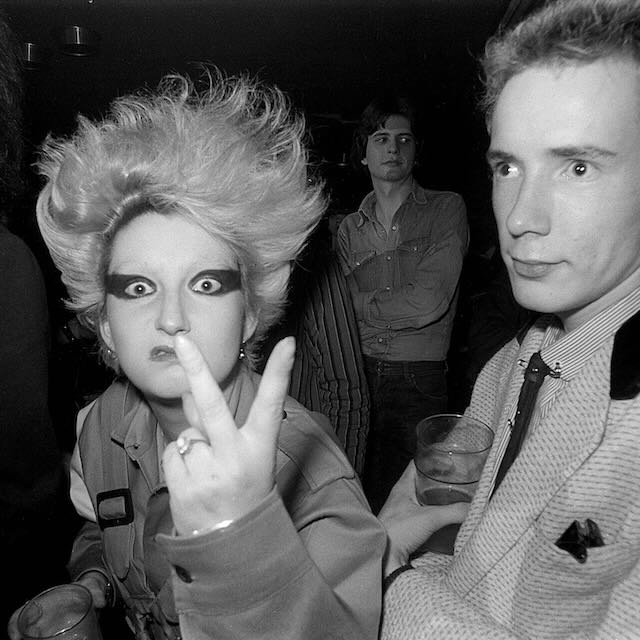
[Jordan Mooney, Johnny Lydon]
To elevate Jordan’s cool factor even higher, chapter 18 includes a short section describing her meetings with Andy Warhol, including a visit to the Factory at its third location, on 860 Broadway. She was particularly in awe of the room filled with his prints “as far as the eye could see”, musing that he’d leave the room long enough for her to take just one to bring home to England. “Oh give us one, Andy. You know you want to. It would be very nice if he had — I’d be a millionaire by now.”
There’s a list of photo descriptions/captions at the front of the book, which I would have enjoyed seeing by each respective image instead of flipping back and forth to get the info.
Essential reading for those interested in the early UK punk scene, this well-researched and written book is packed with fun gossip, middle fingers, and interesting connections — the perfect companion to Savage’s punk bible, England’s Dreaming.
Defying Gravity: Jordan’s Story is published by Omnibus Press; UK £14.99, USD $22.00.
You Might Also Like
 Autonomy – Portrait of a Buzzcock Delivers a Deeply Personal Look at Manchester’s Premier Punk Rockers
 Juvenes Captures Joy Division Through Band Photographer Kevin Cummins
 Sonic Life Vividly Captures 1970’s New York Art and Punk Scene
 #Punk40 Celebrates 40 Years of London’s Music and Subversive Culture Scene
 A Love Parade Arrives in Derry: The Undertones at Millennium Forum